

I’ll be honest — I used to do this, too. I’d forget about descriptive teaching.
When I first started supporting AAC users, I thought the best way to help was to program vocabulary for every single lesson. If I had a fun themed unit or a great new book, I’d make a folder, fill it with every word I thought the student might need, and proudly think, Now they can participate.
I spent hours adding seasonal words, science-unit nouns, holiday terms, character names, and category-specific vocabulary. If the class was learning about volcanoes, I programmed “lava.” If we were reading The Gruffalo, I added every character. If students were sorting leaves, I created a whole page just for “maple” and “oak.”
And to be clear — the intention was good. We’ve all been there.
But over time (and with a lot of real classroom experience), I realized something important:
Our students don’t need perfectly programmed folders to learn language.
They need meaningful opportunities to communicate — opportunities that don’t disappear just because the device doesn’t have the exact fringe word for that day’s topic.
That realization was a turning point for me. I stopped chasing theme-based folders. I stopped feeling like I had to predict every noun ahead of time. And everything shifted when I leaned into descriptive teaching.
What Is Descriptive Teaching?
Descriptive teaching is an instructional approach that reduces the pressure on students to find very specific fringe vocabulary and instead teaches them to communicate ideas using the core words already available on their system.
Instead of asking students to label something, we prompt them to tell us about it.
Here’s what I mean:
If I ask, “Who traveled from place to place planting apple trees?” the student would need to find “Johnny Appleseed.” And realistically… how often will they need to locate “Johnny Appleseed” in their device outside of that one lesson? For most students, probably rarely.
But if I ask, “Who was Johnny Appleseed?” the student can respond with core language like:
- “He go around”
- “He plant apple trees”
- “Make grow”
Not only are those words functional and reusable, but this also teaches something bigger: problem-solving when a specific word isn’t available. And if your student is in a modeling-without-expectation stage, these are powerful words to model during that lesson.
This shift frees communication from the constraints of “the right button.”
Students access language through high-frequency, flexible words that appear on nearly every robust AAC system: go, stop, up, in, on, look, make, turn, same, different, help, want, do.
And suddenly, lessons feel accessible—even if that exact fringe word isn’t sitting on the screen.
Why You Don’t Need Every Word Programmed Into the Device

Many of us assume students need the “correct” nouns preloaded in order to participate. And it feels supportive to add theme words, book vocabulary, or curriculum terms.
But there are a few problems that show up quickly:
Fringe vocabulary is endless.
There will always be a new unit, a new book, a new theme. No device can contain every curriculum term, character name, seasonal item, or classroom concept.
Labeling is a starting point—but it shouldn’t be the finish line.
Labeling can be helpful, especially early on, but describing, comparing, predicting, commenting, and sharing opinions are often more powerful for building functional communication.
Constant programming eats up valuable teacher/SLP time.
That time is often better spent modeling language, responding to communication attempts, and supporting spontaneous use.
Students need flexible language that transfers across contexts.
A word like “Johnny Appleseed” may show up once a year. Words like go, he, like, make, around show up all day, every day.
Descriptive teaching supports functional communication that extends far beyond one themed lesson.
How Descriptive Teaching Strengthens Core Vocabulary
Core vocabulary consists of words used across activities, subjects, and environments. Descriptive teaching shows students how to use these words to communicate meaningful ideas.
Through descriptive teaching, learners practice:
- expressing actions
- describing attributes
- comparing items
- sharing opinions
- explaining ideas
- building sentences
- participating in academic content without the barrier of missing words
This promotes generative language, not memorized labels — and it aligns with how language develops naturally.
How Descriptive Teaching Saves Time (and Reduces Overwhelm)

When you shift to descriptive teaching, a few things happen right away:
- You stop chasing vocabulary.
- You stop feeling pressure to update the device constantly.
- You stop interrupting lessons to add words.
- You stop worrying that your student can’t participate because a label is missing.
Instead, you can focus on what truly moves the needle:
- modeling language in real moments
- supporting understanding
- providing enriched input through the device
- encouraging participation across the whole day
- building meaningful communication (not memorized responses)
This shift supports stronger language development and protects your time — which matters.
When You Should Program New Vocabulary
Descriptive teaching doesn’t mean “never program.” It just helps you choose intentionally.
Vocabulary that’s often worth programming includes:
- family and personal names
- favorite toys, foods, and activities
- high-frequency classroom items
- daily routines
- words that support long-term communication needs
And yes — if “Johnny Appleseed” becomes a special interest or frequently used word for that student, absolutely program it.
The goal is always access to meaningful vocabulary and real communication.
Quick Start: How Teachers Can Try This Tomorrow

- Choose 3–4 core words to model for the day.
- Use open-ended prompts during lessons:
- “Tell me about it.”
- “What does it do?”
- “What do you notice?”
- “How is it the same or different?”
- Model responses on the device using the core words available.
- Celebrate attempts to describe — not just “correct labels.”
- Use descriptive teaching across the full day (not only structured lessons).
This routine builds independence, flexibility, participation, and expressive language for AAC users. If you are ever looking for core vocabulary materials check out our shop. \
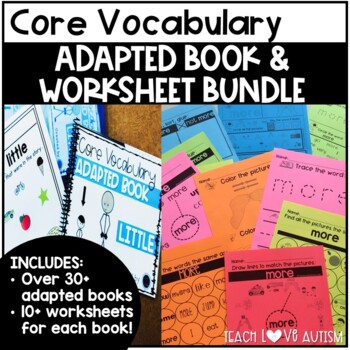
Core Vocabulary Adapted Books and Worksheets BUNDLE
The Bottom Line
If you’ve ever felt overwhelmed by the pressure to pre-program every vocabulary word before a lesson, you’re not alone. Many of us started there because we genuinely wanted to support our students.
But you don’t need a perfectly programmed device to run a meaningful lesson.
Descriptive teaching allows students to participate using the words they already have. It supports flexibility, comprehension, and real communication — and it gives teachers and teams permission to focus on what matters most: modeling, connection, and participation.
They can learn. They can participate. They can communicate.
And descriptive teaching can help make that possible.
If you ever want more support with doing that in your classroom, you can join our Facebook group to learn more!
This post was written by a guest blogger, Andrea Peters M.S., M.Ed, CCC-SLP, BCS-AAC, is a Board Certified AAC Specialist, Certified Assistive Technology Specialist, speech therapist, and owner of Cardigan Speech, where she designs evidence-based resources related to core vocabulary, teacher training, and communication for students with moderate-severe disabilities. She is still in the classroom and has 16 years of experience working with AAC in self-contained classrooms. In addition to a Master’s in Speech Therapy, she has a Master’s in Special Education. With this, she has been able to marry her passion for communication and special education.