
If you have been told to integrate the science of reading in special education, you are not alone. Many schools are moving in this direction and I’m all for it, but sometimes when I talk to other special educators, I get pushback about using phonics to guide reading instruction.
And I get why… because when you teach students with complex needs, you’ve seen what doesn’t work, what feels frustrating, and what gets labeled “not appropriate” way too quickly.
So let’s make this simple and doable: what reading skills actually matter, what research supports, and how to teach those skills in a way that fits real SPED classrooms.
Science of Reading in Special Education: What it Actually Means
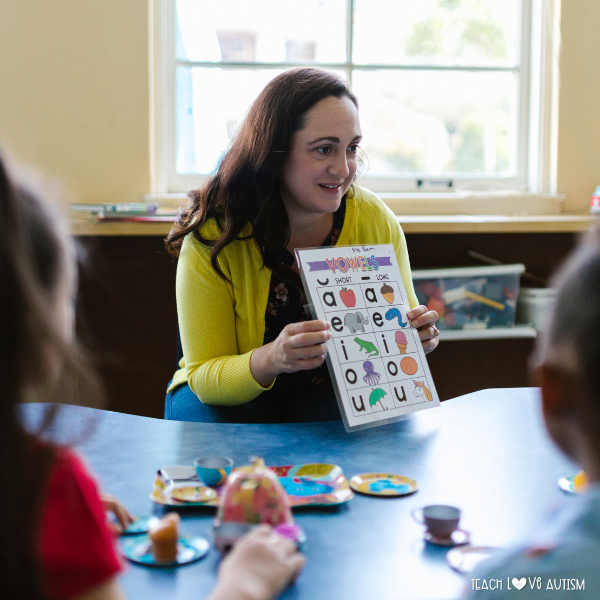
The “science of reading” is a big body of research showing that skilled reading is built through instruction in key areas: phonemic awareness, phonics, fluency, vocabulary, and comprehension.
In science of reading in special education, we’re not reinventing the wheel. We’re making the wheel more accessible:
- more explicit teaching
- more repetition + review
- smaller steps
- clearer student response options
- better progress monitoring
That’s the SPED magic: the instruction stays evidence-based, and we adjust the delivery.
Quick Truth Bomb: Symbols Don’t Teach Students to Decode
There was a time (and honestly, in some places it’s still happening) where the belief was basically:
“If we add visuals to the words, students will learn to read.” And I get how we got there.
Because when you add picture supports, a lot of students suddenly look more successful:
- they can answer more questions
- they can “read” the passage smoother
- they appear more independent
- behaviors might decrease because they understand what’s happening
So teachers see that and think, “Yes! This is the key!”
But here’s the problem: that improvement is often happening because the student is using the visual meaning… not because they’re decoding the print.
In other words, symbols can help a student access the message, but that’s not the same thing as teaching the student how to read the words.
Visuals and symbols can be AMAZING for:
- building meaning and vocabulary
- supporting comprehension
- supporting AAC users (participation + communication)
- reducing frustration so students can stay engaged
And I’m not anti-visuals. Not even close. I love a good support. But symbols are not the same thing as decoding.
Here’s the difference:
- Comprehension support = “I understand what this text is about.”
- Decoding instruction = “I can look at these letters and figure out the word.”
When a student learns decoding, they’re learning the print code:
sounds → letters → words
That means they need explicit instruction in:
- phonemic awareness (hearing/working with sounds)
- phonics (matching sounds to letters/patterns)
- practice reading decodable words and sentences that match what was taught
So yes: keep your visuals. Use them for what they’re great at: meaning, language, access, and communication.
But if the goal is reading, we can’t skip the code and hope pictures do the heavy lifting.
The “do this on Monday” Plan for Science of Reading in Special Education

I am sure you are thinking that you can’t take on learning one more thing about teaching your students with the science of reading in special education. Don’t worry, I’ve made it simple for you. Below are the 5 skill areas, plus exactly what to do for each one.
Science of Reading in Special Education: Phonemic Awareness (PA)
What it is: Phonemic awareness is working with sounds in spoken words (no letters yet). This helps students stop guessing and start understanding how words are made, so decoding later isn’t just memorization.
What to do (5–7 minutes/day):
- Blend: “What word? /m/ /a/ /p/”
- Segment: “Say sat. Tell me each sound.”
- Change a sound: “Say smile. Change /s/ to /t/.”
How to adapt for SPED (quick options):
- Sound boxes + counters: one counter per sound
- Pointing/choices: “Is the first sound /m/ or /s/?”
- AAC supports: model/offer “again,” “first sound,” “last sound,” “help”
Quick Tip: Start with blending + segmenting first. Keep it short and consistent. This is a warm-up, not your whole lesson.
Teach Love Autism resources that fit this:
- BLOG: Ignite Literacy Skills with these Resources for Reading Success
- Rhyming Words Task Cards
- Alphabet Bulletin Board
- Alphabet File Folders with Real Photos including Errorless Teaching Materials
2) Science of reading in special education: Phonics + Decoding
What it is: Phonics is teaching students how letters and spelling patterns match sounds so they can decode words they’ve never seen before (instead of memorizing or guessing).

What to do (10–15 minutes/day):
- Teach one pattern (ex: CVC words, digraphs, CVCe)
- Read a short word list with that pattern
- Read 2–4 decodable sentences using that same pattern
- Spell/Build 3–5 words with tiles or writing (encoding supports decoding)
How to adapt for SPED (quick options):
- Response choices: “Is this cap or cape?”
- Build words with tiles instead of writing
- Point/eye gaze/AAC for “sound,” “blend,” “again,” “help”
- Fewer items, more repetition: 6 words mastered > 20 rushed
Quick Tip: If the text isn’t decodable for what you taught, students will guess. Match the reading to the skill.
Teach Love Autism resources that fit this:
- BLOG: Exploring the Benefits to Phonics Using Literacy Centers
- Winter CVCe File Folders
- Ending Sounds Phonics Digital Task Cards
- Errorless Phonics Digital Task Cards and Boom Cards
- Alphabet File Folders with Real Photos
3) Science of Reading in Special Education: Fluency
What it is: Fluency is reading accurately and smoothly so the brain has room left for comprehension. It’s not about speed. It’s about confidence and automaticity.
What to do (5 minutes, 3–4x/week):
- Repeated reading: same short passage for 2–3 days
- Echo reading: you read, student repeats
- Phrase reading: chunk sentences (short natural pauses)
How to adapt for SPED (quick options):
- Choral reading (read together) for anxious readers
- Shorter text (even 2–3 sentences counts)
- Track print with finger/highlighter strip
- Celebrate accuracy first before speed
Quick Tip: Fluency only works when the student can decode most words in the passage. If it’s too hard, it’s not fluency. It’s frustration.
Teach Love Autism resources that fit this:
- Science of Reading Bundle for Phonics, Comprehension and MORE!
- Cleaning and Home Care Simple Reading Worksheets
4) Science of Reading in Special Education: Vocabulary
What it is: Vocabulary is knowing what words mean, because students can’t comprehend what they don’t understand. This is where visuals can be super helpful.
What to do (5 minutes/day during reading):
- Pick 2–3 key words from the text
- Give a student-friendly definition
- Show a picture/example
- Use the word in a sentence (student repeats, points, or selects)
How to adapt for SPED (quick options):
- Visuals/symbols for meaning (great use of supports!)
- AAC modeling with core words + key vocab
- Student response choices: “Does enormous mean big or small?”
- Multiple exposures: use the same words all week
Quick Tip: Vocabulary doesn’t need to be fancy. Small, consistent instruction adds up fast.
This is where symbols/visuals shine: they support meaning without pretending to be decoding instruction.
Teach Love Autism resources that fit this:
- BLOG: Edmark Reading in a Special Education Classroom
- Big or Small Task Cards
- Big Digital Activities
5) Science of Reading in Special Education: Comprehension

What it is: Comprehension is understanding the message, what happened, why it happened, and what it means. It’s built through language, vocabulary, and explicit teaching.
What to do (5–10 minutes):
Use one simple routine you repeat all year:
- Retell: First / Next / Then / Last
- Story elements: Who? Where? Problem? Solution?
- Main idea: “This was mostly about…”
How to adapt for SPED (quick options):
- Picture choices for answers
- Sentence starters: “I think…” “He felt…” “The problem was…”
- AAC supports: core board for commenting + answering
- Graphic organizers: sequence, cause/effect, story map
Quick Tip: Comprehension can still be taught even when decoding is emerging, just be clear whether the goal is understanding or word reading in that moment.
Teach Love Autism resources that support comprehension:
- BLOG: 4 Simple Ways to Teach Reading Comprehension
- Personal Hygiene Life Skills Reading Comprehension Passages & Worksheets Mini Bundle
- Making a Grocery List Life Skills Reading Comprehension (FREE)
- Restaurant Reading Comprehension Passages and Worksheets
Where AAC + symbol supports DO fit in science of reading in special education

If your student uses AAC, they deserve both: real literacy instruction and real communication access. In the science of reading in special education, AAC and symbol supports help students participate, build language, and show comprehension, without needing speech to prove what they know.
Here’s the key:
AAC + symbols support communication and meaning.
Phonics/decoding teaches the print code.
We can do both at the same time as long as we don’t confuse them.
How AAC + symbols support reading instruction
- help students respond during phonics (choices, “again/help,” first/last sound)
- build vocabulary/background knowledge (visuals for meaning)
- show comprehension (retell, WH questions, feelings, main idea)
- increase engagement and reduce frustration
Teach Love Autism AAC-friendly resources (symbols are the point):
- Blog: Teaching Reading to Non-Speaking Students: 3 Strategies and Resources
- Blog: Simple and Easy Core Vocabulary Lesson Plans
- Core Vocabulary Worksheets: STOP
- Core Vocabulary Adapted Book: EAT
- Core Vocabulary Editable Symbol Adapted Book: HELP (match symbols to student AAC systems)
- Core Vocabulary Communication Board (FREE)
The biggest takeaway
In science of reading in special education, we don’t lower the bar. We change the path.
- Symbols can support meaning and AAC.
- Structured, explicit instruction builds decoding and spelling.
- The most helpful thing you can do is teach the skill, give a clear way to respond, and practice it consistently.
If you want more SPED-friendly reading instruction tips that are actually doable, you can join our newsletter to get weekly emails sent right to your inbox! Sign up here!