

Classroom Strategies for Big Feelings, Transitions, and Sensory Overload
Teaching emotional regulation skills to students with autism is some of the most important work we do, and some of the hardest. Processing emotions, sensory input, and communication can all get tangled up at once, and that’s when we see big feelings, shutdowns, and overload. But with the right strategies in place, teachers and parents can build these skills step by step, at school and at home. Here are the practical strategies I’ve seen work.
Understanding Emotional Regulation in Autism
For many children with autism, the world can feel overwhelming. We talk about this a lot in my Facebook group called the “Teach Love Autism Community“. There are so many things happening all at once: loud noises, bright lights, changing expectations. and it can be difficult to process everything while also managing emotions. That’s why emotional regulation in children with autism is such a crucial skill. Unlike neurotypical children who might naturally develop coping strategies, children with autism often need explicit instruction and structured support to regulate their emotions effectively.
It’s important to remember that meltdowns are not the same as tantrums. A tantrum typically happens when a child wants something, but a meltdown occurs when the child is overwhelmed and cannot control their response. Understanding this distinction helps approach emotional regulation in children with autism with patience, empathy, and the right tools to provide meaningful support.
Strategies for Teaching Emotional Regulation Skills
1. Establish Predictable Routines
Children with autism thrive on structure and predictability. Predictable routines are the foundation for teaching emotional regulation skills. Routines help them understand what comes next and reduce feelings of uncertainty. Unexpected changes can be overwhelming, leading to anxiety and emotional outbursts. To help:
- Use visual schedules with pictures or written checklists to outline daily activities.
- Provide advance notice before transitions (e.g., “In five minutes, we will clean up and move to reading time.”).
- Implement consistent routines at home and school to create a sense of security.
A highly effective strategy is using first-then visuals (e.g., “First we do math, then we play a game”). This simple tool helps set clear expectations and reduces frustration when transitioning between activities.
2. Use Visual Supports
Visuals make a huge difference when it comes to helping autistic students regulate their emotions. Since many children with autism are visual learners, having supports that help them process what they’re feeling and what they can do about it is incredibly powerful. Consider using:
- Emotion charts with pictures of different facial expressions to help children identify and label their feelings.
- Choice boards with calming activities, such as deep breathing, sensory breaks, or fidget toys.
- Social stories to model appropriate responses to frustrating or overwhelming situations.
Many have seen great success with calm-down visual checklists that walk students through step-by-step strategies for self-regulation. These checklists empower students to take control of their emotions by choosing strategies that work best for them.
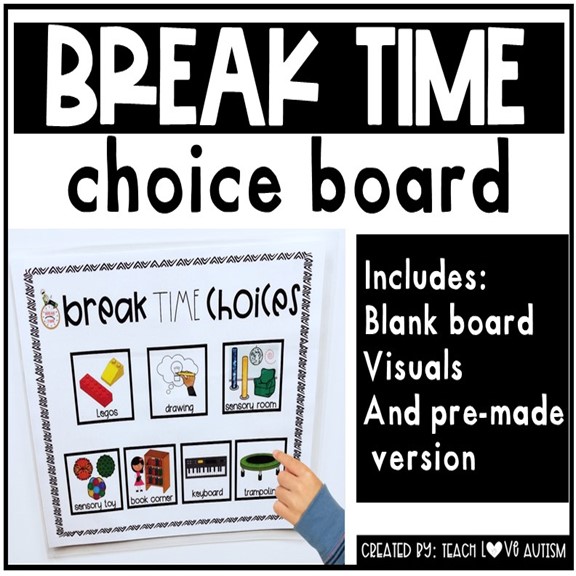
Free Download: Break Time Choice Board
Give students a simple way to ask for what they need before big feelings take over. Grab my free Break Time Choice Board and start using it tomorrow.
3. Teach Self-Regulation Techniques
Kids don’t just “figure out” self-regulation on their own. They need to be explicitly taught coping skills! That’s why teaching emotional regulation skills directly matters so much. Some effective strategies include:
- Deep breathing exercises (e.g., “smell the flower, blow out the candle”).
- Progressive muscle relaxation to reduce tension.
- Mindfulness activities like guided imagery or grounding techniques (e.g., “name five things you see”).
- Coping skill practice using role-play or video modeling.
One effective approach is using calm-down kits filled with sensory-friendly tools. These kits might include stress balls, fidgets, visual timers, or noise-canceling headphones. Anything that helps students regulate when emotions start to feel too big.
4. Create a Sensory-Friendly Environment
Since sensory overload can contribute to meltdowns, modifying the environment can help prevent emotional distress. Try:
- Offering a quiet, low-stimulation space where children can retreat when overwhelmed.
- Providing sensory tools, such as noise-canceling headphones, fidgets, or wiggle cushions.
- Adjusting lighting and noise levels in the classroom or home to reduce triggers.
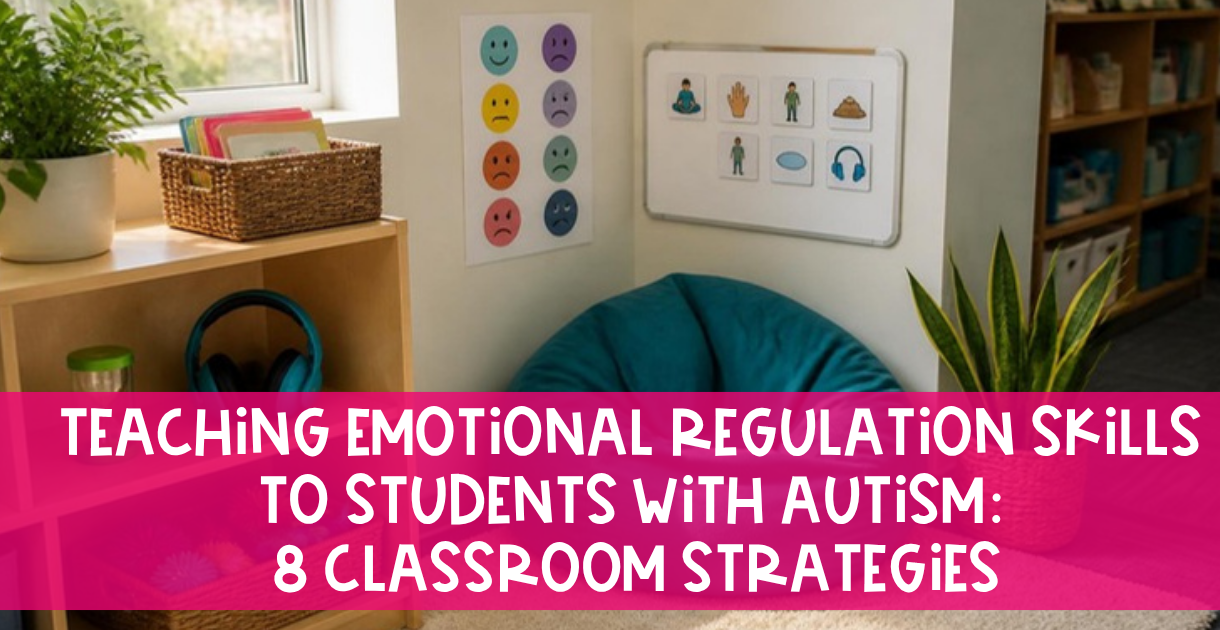
A dedicated calm-down corner in classrooms or at home can be especially beneficial to support emotional regulation in children with autism. Filling it with soft pillows, dim lighting, and calming visuals, and teaching kids how to use the space before they actually need it, can make it a safe place for self-regulation instead of a “time-out” space.
5. Encourage Communication and Emotional Expression
Emotional regulation in children with autism may cause struggles to express their emotions verbally. Supporting communication can reduce frustration and prevent meltdowns:
- Use alternative communication methods like AAC devices, picture exchange communication systems (PECS), or sign language.
- Encourage journaling or drawing as a way to express feelings.
- Teach emotional vocabulary through books, games, and interactive discussions.
A feelings check-in board where kids can point to or place their names under how they’re feeling can be a great way to help them start identifying emotions before they escalate.
6. Implement Breaks and Sensory Strategies
Regular sensory breaks can help prevent emotional escalation and support emotional regulation in children with autism. Consider:
- Allowing movement breaks (e.g., stretching, jumping on a trampoline, or yoga poses).
- Providing fidget tools to help with self-regulation.
- Using calm-down corners with bean bags, soft lighting, and quiet activities.
Incorporating brain breaks into daily routines can be an easy way to ensure kids are regulating their emotions throughout the day rather than waiting until they are already overwhelmed.
7. Model and Reinforce Positive Coping Skills
Children learn by observing adults. Modeling is one of the easiest ways to keep teaching emotional regulation skills all day long. Teachers and parents can model calm behavior and positive coping strategies:
- Narrate emotions and coping methods (e.g., “I feel frustrated, so I’m going to take a deep breath”).
- Praise children when they use self-regulation techniques (e.g., “Great job taking deep breaths to calm down!”).
- Offer positive reinforcement for using coping strategies independently.
8. Loop In Your School Team
You don’t have to figure this out alone. If a student is still struggling, bring it to the IEP team. Your related service providers can help you build regulation supports right into the school day:
- Your OT to help with sensory needs and self-regulation routines.
- Your SLP to strengthen communication supports, including AAC.
- Your behavior specialist to plan proactive supports and teach replacement skills.
What Teaching Emotional Regulation Skills Looks Like in My Classroom
Strategies are great. But what does this actually look like on a regular Tuesday morning? Here’s the routine I come back to again and again. It’s simple on purpose, because simple is what you can keep doing when the day gets messy.
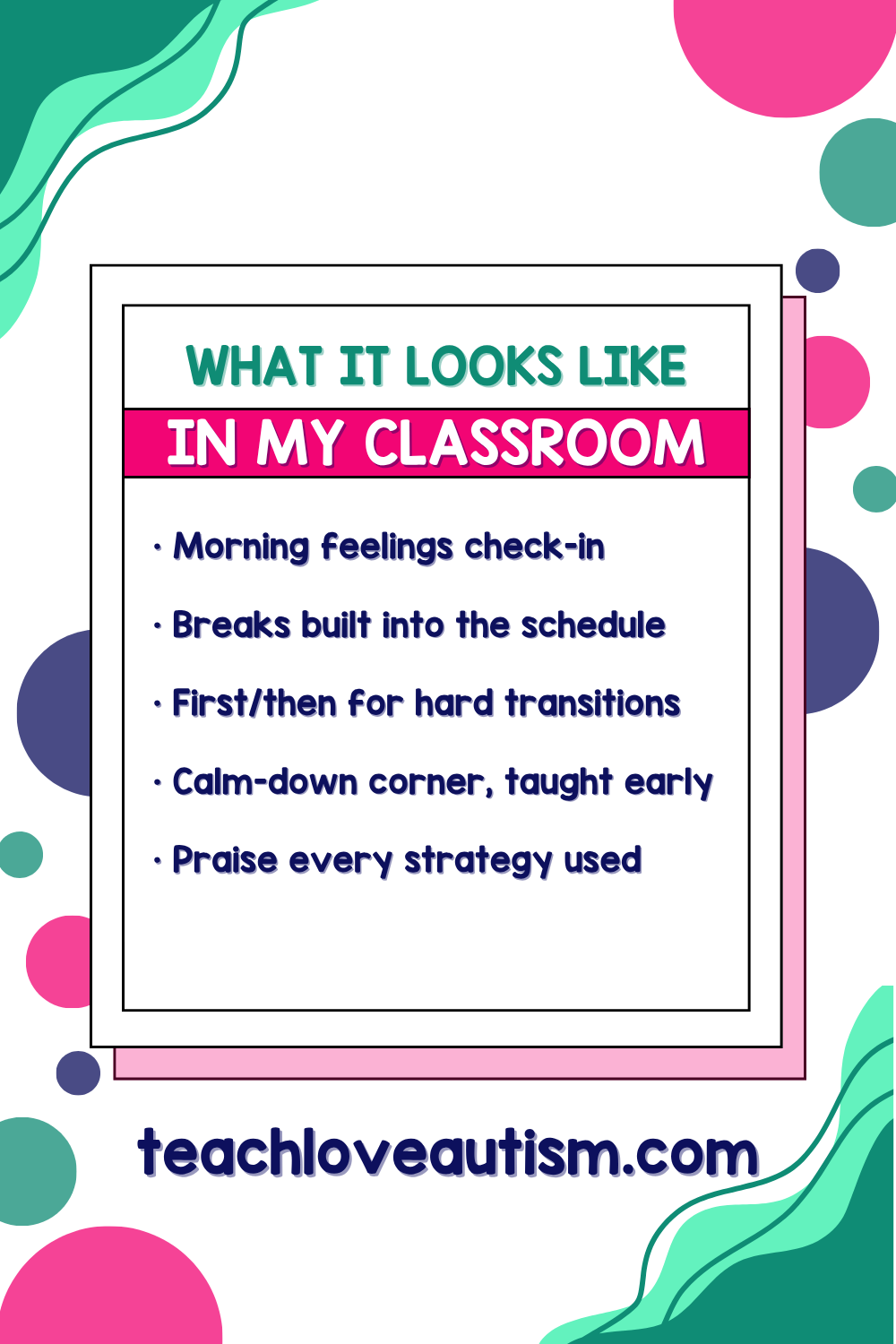
- Morning feelings check-in. Students point to a feeling or move their name on the board. It takes two minutes, and it tells you who might need extra support before the day even starts.
- Breaks built into the schedule. Put them right on the visual schedule so students can see a break coming. A break you can see coming is a lot easier to wait for.
- First/then for hard transitions. Keep the “first” small and deliver the “then” every single time. That consistency is what makes the board mean something.
- Calm-down corner, taught early. Practice using the corner when everyone is calm. Then it’s a familiar tool, not a punishment, when big feelings show up.
- Praise every strategy used. Catch it and name it. “You took three deep breaths and got back to work. That was hard, and you did it.”
Save the card for your planning binder, or share it with your paras so the whole team is on the same page.
Resources to Make This Easier
You don’t have to make all of this from scratch. These are the tools that make setting up regulation supports fast:
- Editable Visual Schedule Boards and First Then Boards for routines and tricky transitions
- Visual Schedules with Icons and Visuals Bundle to build a full-day schedule
- Visual Schedule Social Narrative Bundle with a 5-day implementation guide
- Free Emotions File Folders for practicing feelings vocabulary
- Free Mini Visual Schedule for work and break time
And if you want ready-to-use social narratives for things like waiting, transitions, and asking for a break, the Social Narrative Library inside the Teach Love Resource Membership has preschool, elementary, and secondary versions ready to go.
Teaching Emotional Regulation Skills: FAQ
What’s the difference between a meltdown and a tantrum?
A tantrum usually has a goal, like getting a toy or avoiding a task, and it often stops once the goal is met or nobody is watching. A meltdown happens when a student is overwhelmed and can’t pull it back together on their own. During a meltdown, focus on safety and calm, not consequences. The teaching happens later, when everyone is regulated.
How long should a calm-down break last?
There’s no magic number, but short and predictable works best. Many teachers start with 2 to 5 minutes and use a visual timer so the student knows when the break ends. Watch your data and adjust for each student.
What age can you start teaching emotional regulation skills?
You can start in preschool. Young students can begin by naming a few feelings with pictures and practicing one calming strategy. Older students can learn more strategies and start choosing the ones that work best for them.
Should the calm-down corner ever be used as a consequence?
No. If the calm-down corner becomes a time-out spot, students learn to avoid it. Keep it a safe, positive space students can choose, and teach them how to use it when they’re calm.
How do I teach emotional regulation skills to nonspeaking students?
Lean on visuals. Feelings charts, choice boards, and AAC let students show how they feel and what they need without words. Model using them yourself all day, not just when someone is upset.
Final Thoughts
Teaching emotional regulation skills to students with autism takes time, patience, and consistency. But by providing structure, teaching coping strategies, and building communication, they can be set up for success. Every small step toward self-regulation is a victory worth celebrating!
Teaching emotional regulation skills takes time, consistency, and a lot of patience. But every small step counts, and the progress students make over a school year is truly remarkable!
Save this for later! Pin the image below so you can find these strategies when you need them.